The Renters’ Rights Act: RCCIL Research Analyses Its Impact on the UK Private Rented Sector
The research team at the Research Creative Industries (RCCIL) has released new findings examining the potential impact of the Renters’ Rights Act, widely regarded as one of the most significant reforms to the UK Private Rented Sector in decades.
The report analyses how the legislation could reshape relationships between tenants, landlords, and property investors, while also affecting housing supply, rental pricing, and long-term investment in the sector.
What Is the Renters’ Rights Act?
The Renters’ Rights Act is a major UK housing reform that comes into effect from May 2026, introducing significant changes to the private rented sector.
It aims to strengthen tenant protections by ending no-fault evictions, limiting rent increases, and replacing fixed-term tenancies with rolling contracts.
The Renters’ Rights Act Research Context
The Private Rented Sector (PRS) has grown substantially over the past twenty years and now houses millions of households across the United Kingdom. However, policymakers have increasingly argued that the regulatory framework has not kept pace with the sector’s expansion.
The Renters’ Rights Act aims to modernise rental legislation by introducing stronger tenant protections and restructuring how tenancies operate in England. According to the RCCIL research team, the reforms could fundamentally alter the operational model for many landlords.
Key Changes Introduced by the Renters’ Rights Act in 2026
The Act introduces several major reforms to the UK rental market:
- Abolition of Section 21 “no-fault” evictions
One of the most widely discussed reforms is the removal of Section 21 “no-fault” evictions. The Act proposes replacing this mechanism with a strengthened framework of defined legal grounds for possession.
- Transition to periodic (rolling) tenancies
The Act moves the sector away from fixed-term tenancies toward rolling periodic agreements. The research team notes that while this may provide tenants with greater flexibility, it could also introduce uncertainty for landlords planning longer-term property management strategies.
- Rent increases are limited to once per year
The Act introduces clearer procedures for rent increases and dispute-resolution mechanisms. The research team notes that improved transparency may help reduce disputes between tenants and landlords while providing a more predictable regulatory environment.
- Tenants able to challenge unfair rent increases
- New landlord ombudsman and regulatory framework
- Stronger property standards and enforcement
The legislation proposes enhanced powers for local authorities to enforce property standards and address poor-quality accommodation. RCCIL researchers believe these changes could accelerate the professionalisation of the PRS, particularly among larger landlords and institutional investors.
In addition to examining legislative reform, the RCCIL research team also analysed recent trends in the property sales market, particularly the role of cash buyers in accelerating transactions. The findings suggest that properties purchased by cash buyers typically complete significantly faster than those reliant on mortgage finance.
Potential Market Implications
The RCCIL study suggests the reforms may trigger several structural shifts in the housing market.
Firstly, there may be a gradual reduction in the number of smaller landlords operating in the sector if regulatory complexity increases. Some may choose to exit the market, particularly those managing only one or two properties.
Secondly, institutional investors could play a greater role in the PRS. Large-scale Build-to-Rent developments already operate under professional management structures that are more easily aligned with new regulatory frameworks.
Finally, the report suggests that housing supply in certain regions could tighten in the short term if landlords delay new investments while assessing the legislative changes.

Impact on Landlords and Property Investors
The Renters’ Rights Act represents a structural shift in the UK private rented sector, with significant implications for landlords and investors.
Reduced flexibility around tenancy agreements and rent increases may impact income predictability, while increased regulation introduces additional compliance requirements.
As a result, some landlords may reassess their market position, potentially reducing supply and reshaping investment strategies across the sector.
Advantages and Disadvantages of the Renters’ Rights Act
✅ Benefits
- Greater security for tenants
- More predictable rental costs
- Stronger legal protections
❌ Challenges
- Reduced flexibility for landlords
- Increased compliance burden
- Potential reduction in rental supply
A Long-Term Structural Reform
RCCIL researchers conclude that the Renters’ Rights Act represents a structural reform rather than a minor regulatory adjustment. The legislation seeks to rebalance tenant protections with landlord responsibilities while encouraging higher standards across the sector.
According to the research team, the success of the reforms will depend heavily on how they are implemented and enforced over the coming years.
As the legislation progresses through Parliament, stakeholders across the property industry, including landlords, tenants, and investors, are closely monitoring developments that could reshape the future of renting in the United Kingdom.
RCCIL Insight: How the Act Could Reshape the Rental Market
RCCIL analysis suggests that the Renters’ Rights Act could lead to a significant restructuring of the UK private rented sector in 2026 and beyond.
Increased tenant protections may improve stability for renters, but could also reduce flexibility for landlords, leading some to exit the market or shift towards alternative investment strategies.
Over time, this may result in reduced rental supply, placing upward pressure on rents in high-demand areas.
Guide to the Renters’ Rights Act – FAQ Summary
Will Section 21 “No-Fault” Evictions Be Abolished?
Yes. The Act abolishes Section 21 evictions, meaning landlords will no longer be able to evict tenants without a legal reason. Instead, landlords must rely on specific Section 8 possession grounds, such as rent arrears, anti-social behaviour, or selling the property.
How Will Tenancy Agreements Change?
Fixed-term assured shorthold tenancies will be replaced by periodic tenancies, meaning agreements will roll from month to month without a fixed end date. This gives tenants greater flexibility to move and provides more security against eviction.
What Possession Grounds Can Landlords Use?
Landlords will still be able to regain possession of their property using defined legal grounds, such as:
- Selling the property
- Moving into the property themselves
- Tenant rent arrears
- Anti-social behaviour
However, stricter rules and notice periods will apply, and certain grounds cannot be used within the first 12 months of a tenancy in some circumstances.
Rent Rules and Tenant Costs
How Will Rent Increases Work Under the New Law?
The Act introduces tighter rules on rent increases:
- Rent can generally only be increased once per year.
- Landlords must issue a Section 13 notice to increase rent.
- Tenants must receive at least two months’ notice of a rent increase.
Tenants may challenge rent increases through a tribunal if they believe the proposed rent is above market level.
Are Rental Bidding Wars Being Banned?
Yes. The Act will ban rental bidding wars, meaning landlords and letting agents must advertise a clear asking rent and cannot invite or accept offers above that price. This is intended to create fairer access to housing.
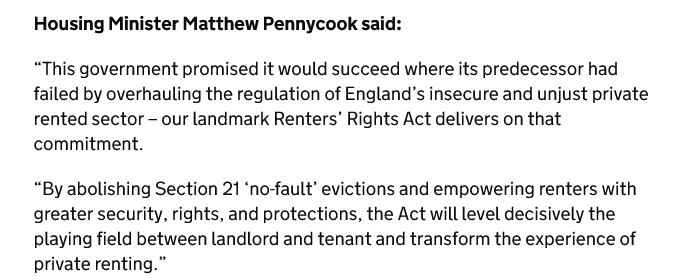
A quote from Matthew Pennycook, a UK Government Housing Minister, said:
Tenant Rights and Living Standards
Will Tenants Have the Right to Keep Pets?
Tenants will have stronger rights to request permission for pets. Landlords must consider requests and cannot refuse them without a reasonable justification. This aims to make renting more flexible for households with animals.
Will There Be Stronger Housing Standards?
The Act introduces improvements to property standards, including:
- Extension of the Decent Homes Standard to the private rented sector.
- Introduction of Awaab’s Law, requiring landlords to fix hazards like damp and mould within strict timeframes.
These reforms are intended to ensure all rented homes meet acceptable safety and quality standards.
Landlord Compliance and Enforcement
What Is the Private Rented Sector (PRS) Database?
A new PRS database will require landlords to register themselves and their properties. This system will:
- Help tenants verify landlord compliance
- Improve transparency in the rental market
- Support enforcement against non-compliant landlords.
What Is the Private Rented Sector Ombudsman?
A new landlord ombudsman scheme will allow tenants and landlords to resolve disputes without going to court. The ombudsman will provide a quicker and more impartial way to deal with complaints and improve accountability across the rental sector.
What Happens If Landlords Break the New Rules?
Landlords who breach the Act may face:
- Financial penalties and fines
- Enforcement action from local authorities
- Additional tenant rights, such as compensation or rent repayment orders.
The reforms significantly strengthen enforcement powers to tackle poor practices in the private rented sector.
Implementation and Timeline
When Will the Renters’ Rights Act Take Effect?
The Act received Royal Assent in October 2025, with reforms being introduced in phases beginning in May 2026. Early changes include tenancy reform and the abolition of Section 21 evictions, while later phases introduce the PRS database and other regulatory systems.
What Happens Next for the UK Rental Market?
With the Act coming into force in 2026, further changes are expected, including the introduction of a national landlord database and ombudsman system later in the year.
The long-term impact will depend on how landlords, tenants, and policymakers respond to the new regulatory environment.
About the Author: Graham Wilson
Dr Graham Wilson is Director of Cultural Policy Research at RCCIL (Researching Creative & Cultural Industries), where he leads analysis on UK housing policy, property investment trends, and broader economic impacts on the real estate sector. With a background in research, innovation, and policy analysis, Graham focuses on interpreting structural changes within the UK property market, including legislation such as the Renters’ Rights Act, evolving investment strategies, and shifts in transaction activity.
The Renters Rights Act Research Audio File can be listened to below: